

4 Habits That Will Make You A More Confident Presenter
If becoming better at public speaking is on your list of goals for 2026, here's the 4 things that made me so good at presenting that I barely need to prep before big meetings.

Welcome to Reframed by Ashley Rudolph. One idea, every week, that changes how you see your career.
In my last newsletter, I wrote about my first in-person event for senior leaders: Off the Record. If being in a room full of other ambitious senior leaders for an afternoon, where you feel seen and inspired sounds exciting to you, join the waitlist. OTR is truly unlike any other networking event or workshop.
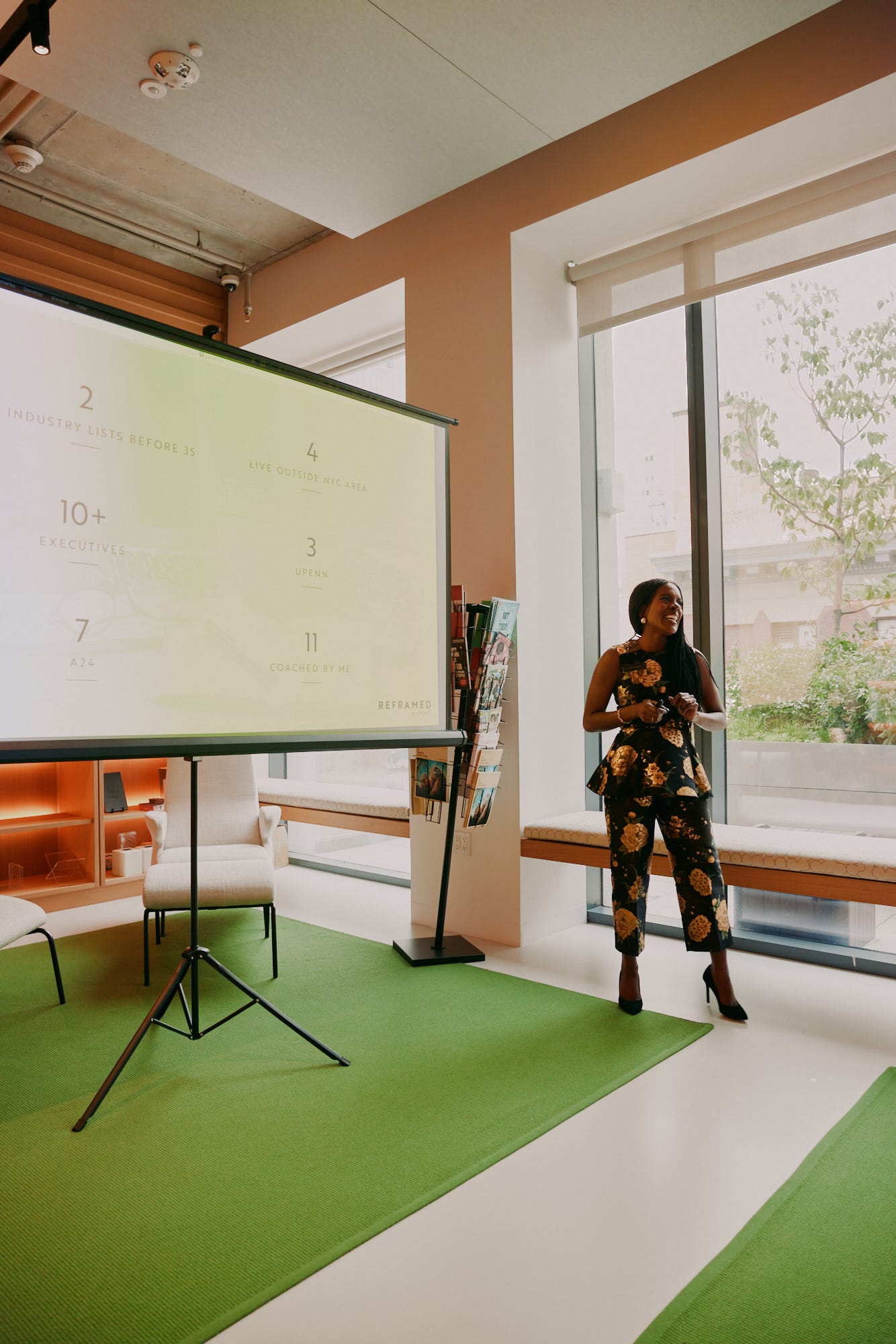
As many as 3 in 4 people have a fear of public speaking. I’ve learned that becoming a great presenter is about preparation. Here’s how to do it (from someone who used to need days to prep for a single meeting).
LenLen is the kind of place you have to lean across the table to be heard in. A former client (now a friend) told me about it. Going there with her for the first time felt like being let in on a secret. The Thai food is, in my opinion, some of the best in the city. On a weeknight it’s all chatter and warm light.
Last week, I shared the magic of LenLen with a different friend. I had a cocktail, my friend had a glass of bubbles, and we were deep in a recap of Off the Record when she set her glass down and paused me mid-thought.
“Okay, first things first,” she said. “How did you get so good at presenting?”
I let the question sit for a second.
It’s a gift to be asked how you do something that you’ve stopped noticing you do. Somewhere along the way, presenting became a thing I just loved doing. Put me in a conference room, hand me a clicker, and I’m in a flow state.
When I was full-time, I’d sometimes even build my decks the hour before a meeting, walk in calm, and land all my points. I love it…which I know may sound a little deranged to the roughly three in four people who feel some flavor of dread about public speaking. FYI - at one point it outranked death on the list of things we’re most afraid of. Death!
I owed her an honest answer, but it was a challenge to remember how I got here. I started with the asterisks: I took two semesters of rhetoric in college and my major that required lots of group presentations. I shared these things because I’m wary of advice that pretends everyone starts at the same baseline.
But I actually do believe most people are wrong when they assume presenting well comes down to natural charisma, that you either have "it" or you don't. Presenting is a skill, like writing a tight memo or running a good meeting, and those skills get built through preparation and reps. Almost all of that work happens before you're standing in front of an audience at work.
So at the table, I shared what came to mind: practice out loud, record yourself, watch it back. The rest? I worked out while outlining this newsletter. Here's the full answer I wish I'd had ready, somewhere between the curry, the crab fried rice, and the cocktails.
INSIGHTS
4 tactics that made me a confident presenter at work
1. Come up with a presentation goal.
Most people treat a presentation as a delivery mechanism: here's the work, here are the numbers, thanks for your time. If that's your mental model, I want you to reframe it. A presentation is an opportunity to engineer a specific outcome. That starts with naming your goal in a single sentence before you draft any content.
In my previous roles, my goals would sound like: I need alignment across three teams. I want the execs to trust me with this initiative. I want my team to leave feeling energized and empowered. Once you have that objective, every other choice — structure, tone, what to include, what to cut — will be easier for you to make.
2. Make an outline before you start drafting your slides.
Once the goal is set, the real question gets simple: what does this audience need, and in what order, to get there? If I was introducing a new initiative, I didn't open with the initiative. I open with the why because a room of people that don't understand the problem will never care about your solution. Slides come last. They exist as a visual aid. Design them first and you'll spend your time reverse-engineering an argument out of a laundry list of bullets, and your audience will feel the lack of cohesion. Use your outline to ensure you’re guiding them to a conclusion.
3. Make your slide titles descriptive and memorable.
I stole this one from a CEO I worked with and it changed everything for me. Most slide titles squander the best real estate on the page with things like: “Q1 Status.” “Financials.” “Project Update.” They’re filler. Instead use your slide headers to make a claim:
Instead of “Project Updates” → Nine of ten projects are on track this quarter or
Instead “Q1 Status” → Our new review process lifted project completion rates by 15%.
This is super helpful in underlining your speaking points. Tight slides + confident speaker = highly effective presenter.
1 INSIGHT
And this isn’t just a style preference. According to Michael Alley’s research at Penn State: audiences shown slides with full-sentence headlines understood and remembered the material better than those shown standard topic titles and the gap in there understanding of the content was still there a week later.
Read that again. Using a pithy headline isn’t just a dash of pizazz.
4. Rehearse out loud and record yourself once.
When I took Rhetoric in college, I gave speeches to a class of 30 (plus our instructor) and was required to watch the recordings for homework. My friend cringed when I told her this and maybe you just did too.
Those reps were awkward and somewhat painful, but they helped. I continued the habit post-grad, I practiced delivering my presentations to a wall, pretending I was up in front of my team. Occasionally I filmed myself, which was still as uncomfortable as it sounds but worth it.
Your camera is honest in a way no colleague will be. It catches the ums, the rushed transitions, the sentence that made sense in your head and nowhere else. You’ll get better by hearing yourself before everyone else on Zoom or in your next meeting does. You can also practice with your favorite LLM and ask it to give you feedback on your delivery and coherence.
CLOSING THOUGHTS
What looks like ease in front of a room is almost never a gift. It’s the result of many small, unglamorous decisions made days earlier, alone, and when nobody was watching. The naturals you’re picturing weren’t always winging it. They just did prep work somewhere you couldn’t see.
You don’t have to be fearless to be good at presenting, just prepared. So before your next big meeting, don’t start prepping by fussing over your slides. Start with a goal.
The confidence comes later.
Good luck. See you next week!
Ashley

Join Insiders
If Reframed helps you think differently about your career, Insiders is where my support gets more personal.
I created Insiders for people who want more than ideas, they want real support, honest perspectives, and a community of smart people navigating their careers. It’s a space ask questions and get answers from myself and other high achievers, and build a sense of agency around how you navigate your career.
When you join, you get:
A monthly Insiders-only coaching call: Bring your real career questions (live or anonymously) and I’ll coach you through them in a supportive group setting. You’ll leave with practical next steps you can actually use.
A growing library of recorded sessions: Get access to past Insiders calls anytime, so you can learn from conversations beyond your own and revisit the guidance when you need it.
Direct access to me: Drop questions in the chat or DM me for added support between calls. You’ll also be in community with other thoughtful, ambitious professionals who are figuring it out alongside you.
20% off Deep Dive Sessions: If you want focused 1:1 support, Insiders get discounted access to one-off coaching sessions: one hour, one problem, one clear path forward.
Join Insiders for $250/year.
If you’re looking for thoughtful career support, sharper perspective, and a community that helps you feel less alone while you grow, I’d love to have you.
#1 !!! I drill this into people!! What is the story!?
Great post Ashley. You combined strategy and tactics in a tight package without overwhelming people with details. Thanks for sharing.