

Before You Roll Out Another "AI Initiative", Read This
Inside my conversation with Maria Weaver, an AI learning & development leader, about which tools to use, the difference between workflows and agents, and one workflow you can steal this week

Welcome to Reframed! Work is complex, career advice shouldn’t be.
I’m Ashley Rudolph and this newsletter is for people who are ready for the next level in their careers and want practical advice that works.
Last week, we talked about getting taken seriously at work and what strategies you can use to get what you want (a promotion, new job, etc).

I had a candid conversation with someone who teaches people how to use AI every single day. Here’s what she shared with me (and her advice).
When it comes to AI, I’ve covered my fascinations (AI boyfriends) and my fears (AI cheapening communication). There’s one topic I haven’t addressed here yet: the impact of AI on jobs. On any given day, there’s a new headline about the impact AI will have on white collar work. Some companies are blaming mass layoffs entirely on AI, while others are investing in their people and preparing them for what’s next. While I don’t fully know the extent to which AI is going to change the way we work, I do know how to help you take control of your career. That hasn’t shifted just because tech is changing.
Today, I want to introduce you to a former colleague of mine: Maria Weaver. She’s focused on solving one of the biggest learning challenges companies face today: helping people actually work with AI and integrate it into how they do their jobs. That means building programs that meet employees where they are, designing for adoption (not just awareness), and rethinking what L&D itself looks like when the tools keep changing. I reconnected with Maria after she left this incredibly thoughtful comment on one of my previous newsletters.
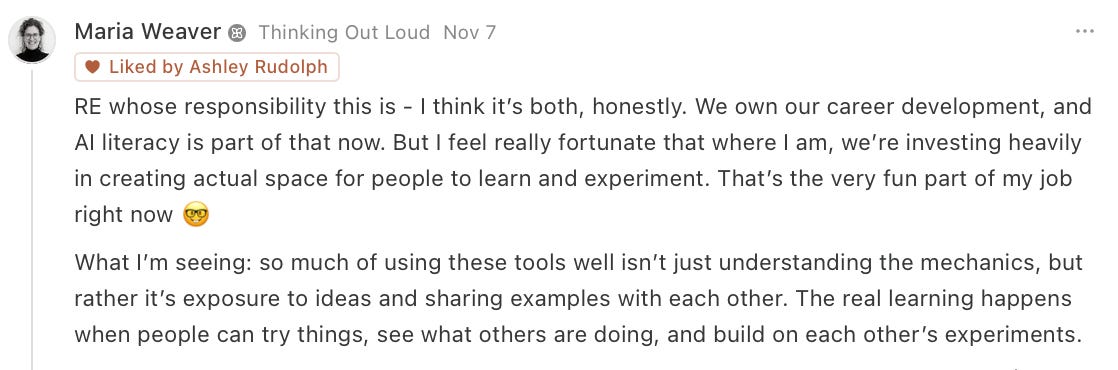
She works at Shopify, a company that’s been notably bullish about AI adoption internally. I’ve wondered what that actually looks like on the inside. Do employees get trained? What’s the culture like? Is any of it actually working? Why or why not?
With the recent headlines about Block, sharing our conversation felt more timely than ever. When we spoke I wanted to get tactical. Given her work, I wanted Maria’s point of view on which AI tools to use, how to get started, the difference between workflows and agents, and practical tips and advice that you all can use, today. I learned a lot.
My Interview with Maria Weaver

Maria’s Thoughts on Building A Culture of Experimentation
Ashley: How are you creating a culture of experimentation and learning at Shopify?
Maria: I’ll be honest, I feel very lucky to work at Shopify, a company where this kind of tinkering is just part of the DNA. We’re an engineer-founded company, and that shows up in how people talk about tools, how they share what they’re trying, and how they ask for help publicly. I don’t take that for granted.
A few things that specifically make it work. Twice a year we run company-wide hack days, and these aren’t just for engineers. Everyone is pushed to find a problem and try to solve it. My team runs programming during these: we source people already doing the thing well for expert demos, build both async and live tutorials, and have an explicit support structure throughout. We also have AI labs built into onboarding, so people are hands-on from day one. And we have a Slack culture where senior people are visibly in the weeds, sharing what they tried, what didn’t work, what they’re stuck on, and people are responding! When you see someone who is more tenured or more senior than you asking a question, it really gives you permission to not know things too.
The thing I keep coming back to is that these tools just require experimentation. You have to be willing to just get in and try things, make mistakes, share them, and keep going. The structure supports that, but the culture has to give people permission to do it without it being polished.
“We have a Slack culture where senior people are visibly in the weeds, sharing what they tried, what didn’t work, what they’re stuck on, and people are responding! When you see someone who is more tenured or more senior than you asking a question, it really gives you permission to not know things too.”
Ashley: What signals to you that someone has figured out how to use AI to rewire how they work, in a positive way?
Maria: What I’m about to describe is arguably what good thinking has always looked like but I think the AI-specific version is real.
The tell isn’t that someone just has more ideas. It’s that they have more ideas and can talk eloquently about each of them. By eloquent, I mean they can unpack them, get under the hood. When you press them, they can walk you through the assumptions they made, the options they considered and ruled out, the questions still open. They’ve genuinely engaged with the thinking. Yes, this is what critical thinking looks like but AI is changing how fast people can get there and the diversity of what they bring to it.
What makes it specifically AI-driven is two things: speed and diversity of inputs. They’re getting to that depth faster than was previously possible, and they may be drawing from fields outside their own domain. That latter part is what I’m most excited about because it enables you to execute the fundamental argument of David Epstein’s book Range which argues that what drives innovation is borrowing and applying concepts from one domain to another. AI makes this identification of what to borrow drastically easier.
For me, when I’m building learning experiences, I use AI to pull out the best characteristics of video game design, medical school training, pilot learning — fields I don’t have deep expertise in. I can surface and apply those frameworks to my context in a way that would have taken significantly more time before.
“Good” thinking still looks like good thinking with AI. It’s more changing how fast you can do it and how wide you can cast your net.
How Maria Uses AI In Her Day to Day
Ashley: What’s your platform of choice and why?
Maria: I use Claude, accessing it through two tools depending on what I’m doing: Claude Desktop when I’m working in Google Suite, Claude Code when I’m working in Obsidian. That said, the honest answer is that the differences between Claude, ChatGPT, and Gemini are smaller than their marketing teams want you to think. What matters more than which platform you pick is knowing what features you’re actually looking for. All of them have versions of these, they just call them different things (I happen to think Claude’s UI is nicer for these features):
Global settings / system prompts so the AI knows how you think and work without you re-explaining every session
Projects or folders so you can organize your context and keep different work separate
Workflows and agents reusable setups you build once and run repeatedly
“The honest answer is that the differences between Claude, ChatGPT, and Gemini are smaller than their marketing teams want you to think. What matters more than which platform you pick is knowing what features you’re actually looking for.”
Ashley: You’ve said you prefer AI “workflows” over fully autonomous agents because you want control. In plain language, what’s a workflow and what’s an agent? What’s one workflow you’ve built that a reader could steal and adapt this week?
Maria:
A workflow is deterministic. You’ve defined the output, and you’ve built the process to produce it.
An agent is adaptive. You provide an input and a goal, but it decides how to get there.
Rule of thumb: if the output looks the same every time, it’s a workflow. If it’s making decisions and creating novel outputs, it’s an agent.
For both, the value is in controlling for context and not having to update the same thing multiple times. I use workflows extensively for planning, project management, stakeholder communication, project updates. The work of consolidating all of that doesn’t require my critical thinking. That’s where I save the most time.
I’ll also add, I’ve been using agents a lot more recently as I’ve built out my team of agents at work. My instructional design agent is a good example: I give it a problem, and it analyzes it against my learning principles, preferred cognitive frameworks, and organizational context — then generates a unique output based on what the diagnosis reveals. Every time it’s different, because every problem is different.
STEAL THIS WORKFLOW→
I record voice notes throughout the day. Whenever I do, I paste the transcript into a Claude skill. It analyzes it, moves the information to the right file, pulls out takeaways and themes, and I’ve built in constraints to maintain nuance and not iron out my voice. That part stays mine. If you’re a verbal processor, this has been a huge unlock. But the principle applies to any recurring note-taking or journaling habit: define what good output looks like once, feed it your raw input, let the AI handle the rest.
“My instructional design agent is a good example: I give it a problem, and it analyzes it then generates a unique output based on what the diagnosis reveals. Every time it’s different, because every problem is different.”
Maria’s Advice for Leaders
Ashley: What advice would you give to a C‑suite leader who wants to improve the way their teams are using AI?
Maria: Grant dedicated time to experiment. An hour a week, a two-hour session every two weeks, whatever the cadence, it needs to be protected time for people to rethink how they do their jobs and figure out where AI fits in.
So much of actually using these tools well requires thinking and unpacking, the kind of work I described above about deconstructing a problem before you know where AI fits. When you’re under a time crunch and have to deliver X by Y date, you’re going to default to how you’ve always delivered. You need space to do it differently before it becomes the default.
I’ll speak directly to the leaders here. You need to see yourselves as part of this time too. Yes, your time is overscheduled and pricey. But actually testing, experimenting, failing, and just genuinely messing around with these tools will give you the capacity to push teams to use it more extensively. This matters for two reasons. One, it gives people permission to take the time to experiment. And two, it gives you the actual understanding of these tools so you can push to the boundaries of how to use them, not just talk about them.
FINAL THOUGHTS
Talking to Maria shifted something in me. What stayed with me was her point about critical thinking. That good thinking still looks like good thinking whether you use AI or not. AI just changes how fast you can get there and how wide you can cast your net.
In a moment where it feels like the machines are taking over, that’s actually reassuring. The thing that makes you good at your job isn’t going anywhere. Critical thinking, creativity, the ability to connect dots across domains. Those things are still differentiators.
If this conversation made you want to try even one thing this week, go after it.
Good luck. See you next week!
Ashley
ABOUT MARIA
Maria Weaver is a learning and development leader who builds programs that change how people think, perform, and grow. Her work sits at the intersection of learning science, program design, and organizational strategy. She’s led high-impact initiatives at Shopify, General Assembly, and Udemy, always with the same throughline: make learning useful, make it motivating, and tie it to outcomes that matter.
Maria is obsessed with learning about learning. How do people actually acquire knowledge? How do you get them from information to action? Outside of work, she writes, crafts, and is always trying to be a beginner at something — most recently, spending a month in France trying to get better at actually speaking the language.
Subscribe to Reframed.
I share fresh leadership and career insights every Monday, right before you tackle the rest of your week. If you’re curious, people who work at the following companies subscribe to Reframed.
My newsletters are good enough to gatekeep, but more often it’s one that people forward, screenshot, and share with the people they care about.
This was so good!! I didn’t even know this was a job one could have, but what a critical role these days.
The point she made about how leaders need to carve out space each week for learning/experimenting with tools really resonated with me—I’ve been meaning to do this with my own team and hearing about her workflows has put a fire under my ass haha.
Looking forward to more interviews! Great series.
This was such a great interview, Ashley! Thanks for sharing and thanks so much Maria for your perspective. I do think that AI helps accelerate tasks and provides ways to devote time to more important things, like deepening relationships, and talking through ideas.
Where I am concerned, though, is the disappearance of entry-level jobs because of AI. Obviously this newsletter is targeted toward people who are looking to get to the VP level, but I do think it’s worth mentioning that we are facing a a frightening cultural shift where college graduates won’t be able to get into the workforce as easily. Hannah Horvath recently wrote about this, and I’ve been sharing it with everyone:
https://yourbrainonmoney.substack.com/p/economy-booming-not-for-you