


Every other Thursday, I share a curated roundup on the culture of work.
Understanding how work is evolving is a real competitive advantage. The people who get ahead aren’t just working harder, they’re paying attention to how the game itself is changing. Consider this your shortcut to what matters most in modern work.
Oxford just named 'Rage Bait' the word of the year. I think it’s a direct reflection of how the workplace has evolved. In a previous edition, I talked about how thorny everyone seems to be at work these days but is RTO it’s own version of rage bait?! I have a take on this in the second link—read it, then tell me if I'm being too cynical in the comment thread.
Links from The Washington Post, Fast Company and Vox.
Total read time: <8 mins.

The vibe in this week’s roundup is giving: a dash of negativity, a sprinkle of scarcity, and a whole lot of “what now?” energy. We love drama!
My Links
THE ARTICLES I CAN’T STOP THINKING ABOUT THIS WEEK
#1: You might hate these companies’ ads. That’s the point (The Washington Post) | Free link
You know how sometimes you’re on social media and someone says something so ridiculous that it irritates your spirit? This piece outlines exactly how tech companies are leaning into that kind of outrage as a marketing strategy.
Quick sidebar: this is one reason why I love ANU’s trend coverage. While online chatter may lead you to believe that rage translates to sales (the views! the impressions! the engagement! money!), she’s been pointing out that this isn’t always the case. And now people are catching up to her.
Back to the article. The funniest part to me was how genuinely shocked the founders of Cluely and Friend seemed after realizing that going viral does not automatically lead to sales. Cluely’s CEO even claimed to have grown to $7M ARR in July, btw. These two paragraphs say it all:
Tapping into public outrage may not pay off in the long-term. Cluely pivoted from its AI cheating tool, which never materialized, to a more conventional AI note-taking app this month. Onstage at the TechCrunch Disrupt conference in October, Lee admitted that actual revenue has been harder to come by than the initial burst of attention.
Schiffmann said Friend’s investors are interested in sales, but he is more concerned about “being seen as someone who understands culture.” In the future, he added, he hopes people will look back on his ad campaign as a “ginormous art installation.”
Maybe the whole piece was just one big rage bait attempt?! Either way, it’s all a prescient reminder that attention is not a business model.
#2: The high-achiever’s paradox: Why reaching your goals won’t make you happy (Fast Company)
The title’s a bit of a gut punch but I’m including this one because I learned two concepts that I think will resonate with y’all: arrival fallacy and the hedonic treadmill. And, I’ll be honest, the suggested fixes in the article didn’t fully land for me (it happens!). So if you prefer to save a click — here are the definitions that are worth knowing, followed by my recommendations for what to do if you feel stuck in the “achievement hamster wheel”:
Arrival Fallacy: This is the belief that once you reach a specific milestone you’ll finally feel happy, calm, confident, or “settled”. But in reality, the feeling is usually short-lived (I’ve been there!!). You arrive and then immediately start aiming for the next thing.
Hedonic Treadmill: The cycle of returning to your personal baseline of satisfaction no matter what happens, good or bad. You adapt quickly. Wins fade faster than you expect, and without realizing it, you raise the bar on yourself again and again.
Here’s my take on what to do if you’re caught in this loop:
1. Pause. I talked about something similar to the above with Brie on The Portfolio Career Lab podcast — an idea I call “inertia disguised as ambition.” [listen here] High achievers tend to advance quickly because of their talent and intellect and that momentum becomes its own force. Sometimes you climb because you can, not because you’ve reflected on whether you want to.
A real pause lets you ask:
What do I actually want?
What are my values?
What parts of my work do I genuinely enjoy?
What do I want my reputation or legacy to be?
Most people skip these questions and just keep going.
2. Count your wins (because most high achievers don’t). This is the #1 pattern I see. High achievers struggle to claim and appropriately frame their wins because we move too fast to notice them!
If you don’t acknowledge what you’ve already done, your next milestone will never feel like enough.
3. And the one that’s helped me the most this year: stop taking yourself so seriously. Not in a judgey way of course. High achievers can get so locked into performance mode that everything starts to feel urgent and high stakes. Sometimes I truly have to tell myself, “get a grip” lol. The second I do, I loosen up and focus on what matters.
#3: Here’s a glimmer of hope about AI and jobs (Vox) | Free link
I appreciated this piece because the AI job-loss conversation is still everywhere, but it’s rarely as simple as “AI is taking all the jobs.” Apparently, some losses are real; while some are CEOs placing early bets and blaming AI before it’s even fully adopted internally. The stuff that memes are made of!
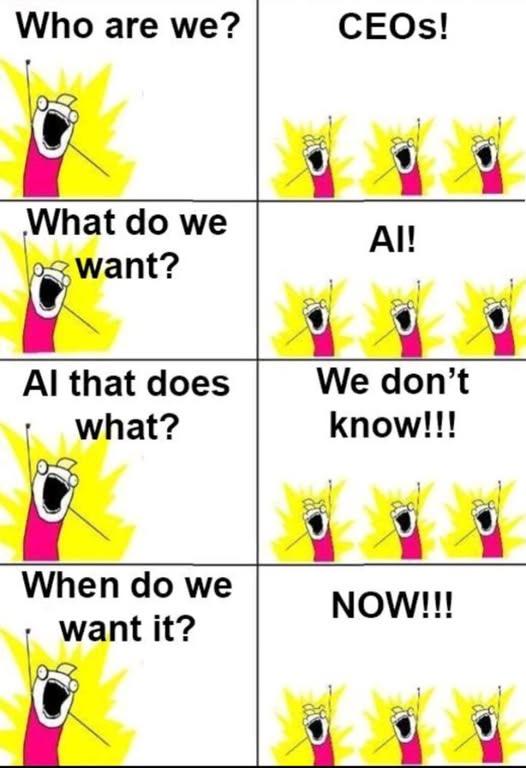
Lol.
Anyway, the expert gives two examples in the article that paint a more nuanced picture of what’s to come. He compared what’s happening with AI to two advancements that impacted real jobs,
Google Maps and its impact on taxi drivers → Wages dropped, but far more people could enter the field via apps like Uber/Lyft.
Spellcheck and its impact on proofreaders → Wages went up, but fewer people were qualified to do the job since the skill became more specialized.
There’s also other great gems throughout. For me, it all was a useful reminder that AI’s impact will likely look different across professions. If you want more — Dr. Fei Fei Li’s episode of Lenny’s podcast shares why she doesn’t think AI will replace jobs wholesale.
I’m curious how y’all are thinking about it.
My Newsletter
IN CASE YOU MISSED IT: THIS WEEK’S NEWSLETTER

If you’re reading this and thinking, “sooo…what’s next for me?”. This week, I chatted with Cydnee DeToy about the complexities of knowing when to stay vs. when to move on from your job. Both Cydnee and I had the experience of leaving jobs too soon. I really appreciated her advice on slowing down and identifying the path that’s right for you — especially her point about there never being a “perfect” time to leave. I’ve learned that you owe it to yourself to interrogate your options before taking a leap.
If you haven’t had a chance to read it yet, it’s a great one!
That’s it for this week! From my browser to yours.
Ashley
LET’S CONNECT
If we’re not connected yet—let’s change that. I’ve been loving getting to know some of you. Connect with me on LinkedIn and say hey. 👋🏽
Arrival fallacy is SO REAL!!!
LOL that photo. I feel this so hard. ‘What if we used AI!?’ Me: ‘Sure. For what purpose?’ Them: gestures wildly in the air.