


We’re back! I took a little hiatus to collect myself. It was needed.
Every other Thursday, I share a curated roundup of things directly and loosely related to the culture of work. Throughout my career, I’ve noticed that the people who get ahead typically aren’t working harder; they’re paying attention to the invisible forces shaping their careers.
This week, we’re looking at the "human" side of it all: how to stop people-pleasing (effectively), why we need more edgy and honest commentary online, and how a clean house might be the ultimate employee benefit.
Links from Fortune, The New Yorker, and Rich People Shit.
Total read time: <8 mins.

The vibe this week: honesty. My favorite links just happened to be about what happens when we ask for more, lean into the snarky and humorous versions of ourselves, and stop behaviors that no longer serve us.
My Links
THE ARTICLES I CAN’T STOP THINKING ABOUT THIS WEEK
#1: How to stop people pleasing for real (The New Yorker)
I loved this one. When I am contextualizing people pleasing tendencies with a client, we unpack the behaviors that are actually survival mechanisms in high-pressure workplaces. I was aware of fight, flight, fawn, or freeze responses but this article introduces “unfawning”: the process of breaking the reflex to appease others.
I’m obsessed.
When I think about work contexts, unfawning looks like not being the first to volunteer for the “office housework,” not jumping in to rescue a project when a peer drops the ball, and resisting the urge to agree with the loudest, most confident person in the room just to feel safe. (If you notice a tendency to defer to others simply because they are more senior, you might also be dealing with Authority Bias. This article might also be of interest to you.)
Another interesting point the authors made is that the internet and by extension, our digital workplaces turns us all into fawners. The article states, “sociologist Sherry Turkle described how the loose ties of digital life make us feel exposed and precarious, causing us to scrabble for status and other measures of safety. The internet, in other words, turns us all into fawners.”
Learning to “unfawn” might be the most important boundary-setting tool you use this year.
#2: Does your company offer cleaning services as a benefit? (Fortune)
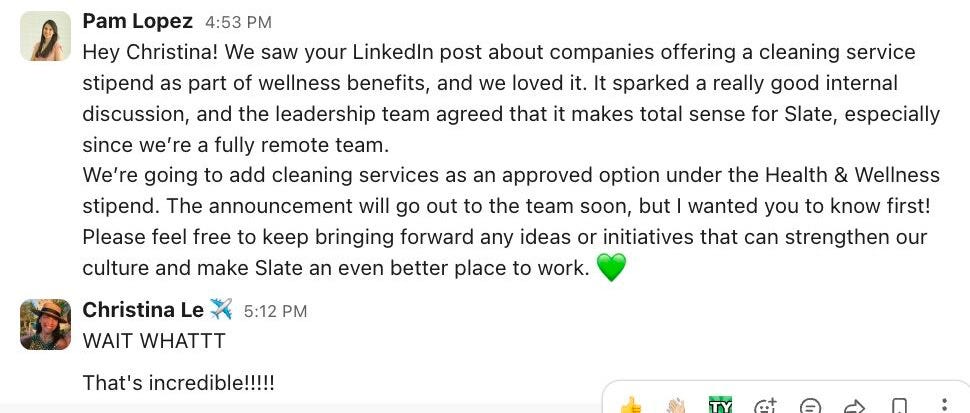
I saw Christina Le’s post on LinkedIn a few weeks back about how her company reacted to her post about offering cleaning benefits as a health and wellness perk and it, deservedly, got a ton of attention. I know many of you here are executive leaders or in HR. If you’re refreshing your corporate benefits but haven’t thought about home cleaning as a perk, she makes a compelling argument.
While wellness stipends and gym perks “are fine,” she wrote, “not everyone wants to spend their limited free time on a treadmill. For a lot of us, a clean home does more for our well-being than another obligation.” Le argued a home-cleaning perk could be more “practical. It’s human. It takes one thing off the list.”
And much to her surprise, her company not only responded, but quickly acted to add cleaning services as a benefit for employees.
Her company (Slate) didn’t just listen; they acted. Very cool.
#3: The internet’s newest “secret” guide to rich people is on Substack (Rich People Sh*t)
The first newsletter on RPS (Rich People Shit) is about invite-only fake Birkin parties on the UES, which scratches both my nosey itch (*cough, cough* curiosity) and my love for humor. I can’t wait for more. But beyond the gossip, Carson’s writing made me reminisce about the workplace/tech rags of the 2010s. We need more of this.
Don’t get me wrong. I understand why this type of writing disappeared. Rich people became increasingly litigious (remember when Hulk Hogan and Peter Thiel went after Gawker?!), the internet became polarized (internet mobs chomping at the bit to find their next cancellation victim), and content became a monetization engine that rewards being deferential. Quite the compound effect. And as a result, you have more of what we have today: content that lacks a clear POV or any edge. So whenever I see something like RPS, it immediately grabs my attention.
And I’m locked in, I immediately texted my friend Chris about it and we took a trip down memory lane.
If you subscribe, I’m curious to hear what you think of it.
My Newsletter
IN CASE YOU MISSED IT: RECENT NEWSLETTERS
You get a 2-for-1 deal this week because both of these will help you start off 2026 strong. They’re both about incredibly effective low-lift/high-leverage ways to get ahead.

Politics has a bad rap. And when I think about the political games some people play at work, it should. The backchanneling, maneuvering, and throwing people under the bus for your own personal gain - yeah, that stuff is nasty. But this newsletter is about playing good politics: understanding how to wield power and influence to actually get things done.

Did you know that experts have blindspots? And those blindspots make them register their expertise as “easy”, rather than the complex skills they actually are. And often, leveraging those exact skills are how you get ahead at work. This week’s newsletter is about identifying those "easy" wins and flexing them to build a strong internal brand.
That’s it for this week! From my browser to yours.
Ashley

I can’t stop thinking about the cabin we spent a few days in in over the weekend. So here’s another picture of the snow. Since we’re getting more snow in NYC this weekend, I’ll be cozying it up once again.
And if you haven’t yet, subscribe to Reframed to join leaders from Google, YouTube, Chanel, Meta, TikTok, and Starface Beauty every week →
Ashley! Thank you so much for including and I can’t wait to keep up to your expectations ❤️