

4 Ways to Get Taken Seriously at Work (Even When People Underestimate You)
How I went from a 5% merit increase to a VP promotion in one week, and the 4 strategies I used to build credibility before I had the title

Welcome to Reframed! Work is complex, career advice shouldn’t be.
I’m Ashley Rudolph and this newsletter is for people who are ready for the next level in their careers and want practical advice that works.
Last week’s letter about delegating came up in a few of my coaching meetings, which means you’ll probably want to read it if you missed it. This week’s newsletter is about how to get taken seriously.

I thought a more senior title meant people would automatically take me seriously. I was wrong. Titles don’t manufacture gravitas, but your self awareness, your ability to articulate your impact, and your relationships do.
A few months ago, I read a newsletter by Shelbi Jones about a conversation happening online: the desire to be taken seriously. I shared my thoughts:
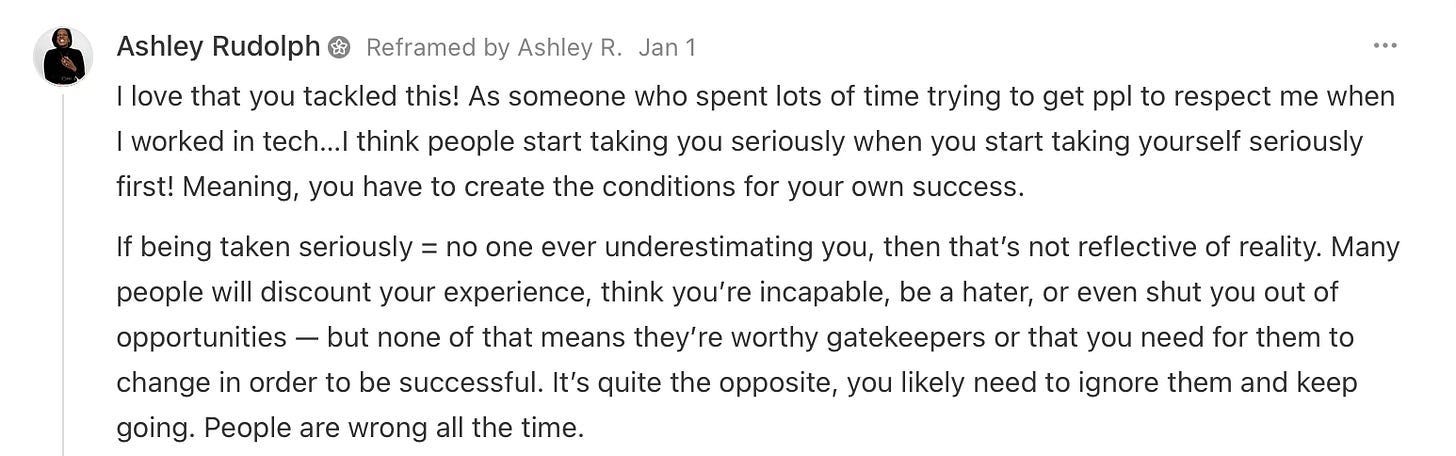
People are wrong all the time.
In my career, if I had waited around for everyone to take me seriously I wouldn’t have made it to the executive level.
Take my promotion to Vice President as an example. It didn’t happen because someone, somewhere started taking me seriously and thought I had rightfully earned a seat at the executive table.
I wish!
Instead, I walked into my performance review as a Senior Director and left as a Senior Director, without a promotion.
Don’t get me wrong, my review was glowing, but the reward for my hard work and operating at the next level was an underwhelming 5% merit increase. When I was in that room, sitting across from my manager (the CEO), receiving the news, I had that all-too-familiar “hot” feeling come over me. I felt anger, frustration, and defeat. What do you mean my hard work, my leadership, and my scope was only worth 5%?!
I realize now that that feeling was a useful data point. It signaled that something was misaligned between what I knew to be true about my role and what I was being offered. I knew I was operating at the executive level — there was no question. So when the CEO asked how I felt about my review, I mustered up the courage to directly ask for a follow-up conversation where we would discuss becoming a VP.
I was promoted the next week.
People are wrong all the time.
THE FRAMEWORK
4 Ways to Get Taken Seriously At Work
I climbed the ladder quickly and landed in high-responsibility roles at a young age. Early on, I confused seniority with credibility. I thought the higher my title, the more seriously people would take me. I was wrong. Titles don't manufacture gravitas, but your self awareness, your ability to articulate your impact, and your relationships do.
I had to learn how to earn it, instead of waiting for the moment when people magically started taking me seriously.
When I think back to that review with the CEO, I felt comfortable pushing back because I had been building toward it for years. I just didn't have a name for what I was doing until now. Here's what worked for me:
1. Make your impact visible.
If you’ve read Cal Newport’s So Good They Can’t Ignore You, you know what this is about. When I walked into my review, I was confident in my output. My promotion case was prepared, my proof points were indefensible. I knew I was VP material whether or not I got the title that day.
I also had an advantage: I reported directly into the CEO. He saw my impact firsthand.
PRO-TIP →
Getting good at this is important, even if you don't report into a C-suite exec or decision maker. It forces you to reframe your relationship with your manager. They are ultimately your proxy in rooms you're not in. What they say about you depends entirely on what you give them to say. If all you're sharing in your 1:1s is status updates (this project is done, that task is complete) then what they'll take back to decision-makers is "the work is getting done." That's forgettable. Instead, think about feeding your manager headlines. Not "I finished the project" but "I cut our onboarding time in half." Not "the campaign launched" but "we generated 200 qualified leads in two weeks." Those are things that get repeated. And when you do find yourself in the same room as a decision-maker, start sharing those headlines directly.
2. Build relationship capital.
This one is important for high achievers. I like to joke that I’m “Little Miss Do-it-all-myself,” and it trips me up sometimes. In this situation, I had built up enough trust and rapport with my manager that pushing back was received well. I had relationship capital. If we didn’t have a strong relationship, my pushback (while valid) could have backfired.
This works in other use cases too. In general, think about how your relationships and affiliations can help make your case stronger, no matter the context. For example, if you’re searching for your next role or if you’re trying to build your network (particularly when you don’t have an existing relationship to lean on) things like credentials, shared contacts, or brand names in your portfolio carry weight too. Relationships and brand name recognition make it easier for people to take you seriously.
3. Understand your gaps.
This one is key. Sometimes your coworkers provide valuable data. For me, observing senior colleagues helped me unpack what the expectations were for executives at the next level. That became my benchmark. One way you could do the same is by reflecting on the following questions:
Have any of your peers reached the next level — why or why not?
Who’s getting opportunities you’re not, and what’s actually different about their experience, credentials, network, or skill sets versus yours?
Observing colleagues at the next level helped me level up multiple times in my career. It helped me observe things like the meetings they attended, the decisions they owned, and their purview — which were useful cues for how I went about measuring my own performance and taking on additional responsibility (strategically). When I was gunning for a Vice President role, the only difference between me and the next level was my title. I had invested time in understanding my gaps and addressing them. And because I had done that legwork, I had the confidence to eventually be direct about what I wanted.
WORK WITH ME
If this feels like the kind of strategic support you need in your career, I have a few 1:1 coaching slots opening in the spring. My clients have stepped into more senior leadership roles, improved their relationships with their CEO, and found the confidence to take control of their careers. If this sounds like what you’re looking for - let’s chat.
4. Make your ambitions known.
I walked into my review wanting a conversation about earning the next step. The CEO walked into the conversation wanting to adhere to a new compensation framework rolled out across the company. He wasn’t aware I was expecting to be promoted.
Looking back, I should’ve been much more direct about my intentions and expectations going into the meeting. Being upfront would have ensured he had the full picture walking in, and perhaps changed his approach. Our misalignment wasn’t actually a reflection of my performance, he was just a busy person with competing priorities trying to make the best decision he could. Hearing him out, sharing how I felt, and working together on next steps helped us co-create a solution.
My advice? Be direct, don’t assume that your manager knows about your career aspirations. Tell them.
CLOSING THOUGHTS
These four things are exactly what you need to do to get others to take you seriously. They are things you can control. These actions help you show up as the best version of yourself, regardless of how others *may* perceive you.
Make your impact visible. Build relationship capital. Understand your gaps. Make your ambitions known.
If you’re not confident about 1–2 of the things on my list, good. Now you have clarity about where to focus your time.
And if you do all four and someone still doesn’t take you seriously?
People are wrong all the time.
Keep going.
Good luck! See you next week, I’ve got a very special announcement.
Ashley
Subscribe to Reframed.
I share fresh leadership and career insights every Monday, right before you tackle the rest of your week. If you’re curious, people who work at the following companies subscribe to Reframed.

My newsletters are good enough to gatekeep, but more often it’s one that people forward, screenshot, and share with the people they care about.
People are wrong all the time! So many good tips here. I needed this advice when I was working in corporate tech. Those review conversations with the 5% merit increase 😩